Ágora Infantil is a participatory democracy program delivered in schools that involves students in municipal decision-making. To date, it has been implemented in more than 60 municipalities, with over 4,000 girls and boys taking part.
Objectives
Ágora Infantil aims to strengthen the role that children and adolescents play in our society by creating spaces where young people can deepen their understanding of how public administration works, express their opinions, identify needs, learn to listen, show solidarity and empathy, begin to build consensus, and make collective decisions while respecting diversity.
In ongoing dialogue with technical teams and public officials, Coglobal has promoted and developed a vision of citizen participation as a process of democratic and social inclusion that enhances the capacity for influence among the least empowered and most vulnerable groups. For Coglobal, the participation of children and young people in public life is itself an act of inclusion—one that gives a voice to those who are not often heard.
Additionally, we approach work with minors from an intersectional perspective, understanding that they do not form a homogeneous group. In our society, experiences vary greatly depending on whether one lives in an urban or rural environment, in contexts of scarcity or abundance. It is not the same to be a boy or a girl, to belong to a minority group, or to have reduced mobility. Nor is participation experienced the same way by those with or without strong social skills, extroversion, leadership roles, or those more isolated within their peer groups.
Our efforts are focused on building participatory processes that gradually increase the influence of those who may find it more difficult to take part.
Recognitions
- Good Practice in the Public Administration Innovation Bank of the National Institute of Public Administration (INAP), Spain.
- Recognized as a Practice of National Educational Interest by the National Administration of Public Education of Uruguay.
- International Good Practice in the COMPARTE Guide of Good Practices in Participation and Local Democracy of the National Autonomous University of Nicaragua, Managua.
- Included in the Practice Bank of the Laboratory of Participation and Democratic Innovation of Andalusia (LAB 717) at the University of Granada.
- Included in the PARTICIPANDA Practice Bank of the Observatory of Childhood and Adolescence of Andalusia.
- Included in the European practice bank of the YouthPB Accelerator.
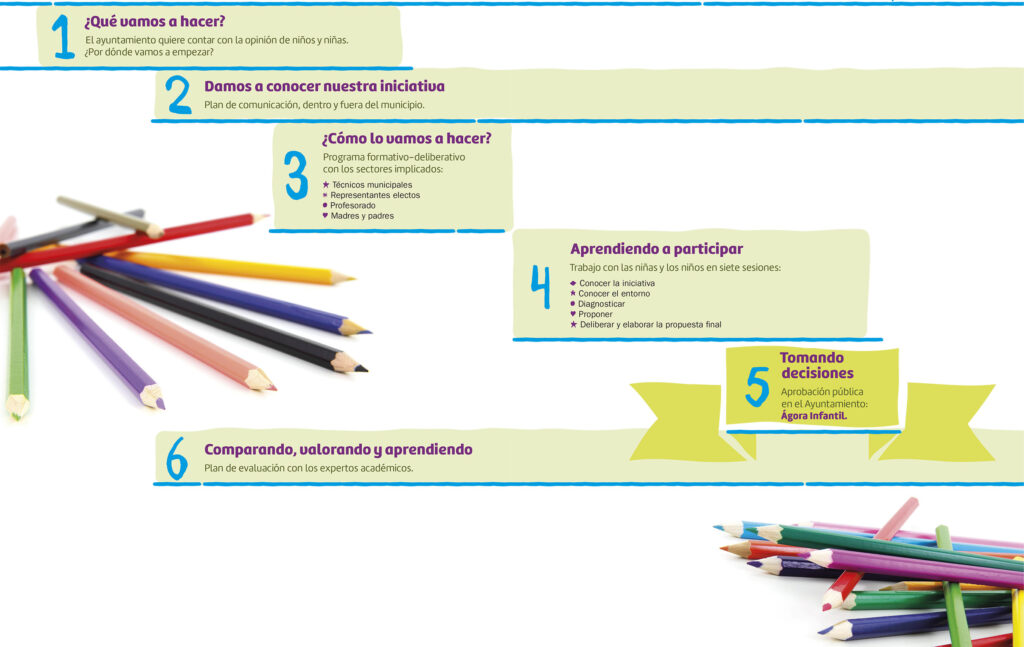
How We Implement Ágora Infantil
Ágora Infantil works with full class groups during school hours, involving children aged 10 to 14. Their task is to develop and prioritize proposals to be presented to their local government for implementation.
This initiative enables young people to participate in shaping municipal initiatives that matter to them, contributing ideas rooted in their own experiences and perspectives. The groups of children and adolescents analyze their local environment, generate ideas, deliberate, and collectively build a proposal, engaging in dialogue with the City Council or other local government bodies.
The program is implemented at the invitation of the local government, in collaboration with participating schools.
What Kind of Proposals Do They Create?
Through Ágora Infantil, deliberative processes are carried out to involve participants in decision-making on issues that affect them, including:
- Recreation and cultural programming
- Facilities and spaces for children and youth
- Awareness campaigns on environmental issues, community coexistence, gender equality, and more
- Initiatives that promote local identity
These proposals reflect the interests, needs, and viewpoints of the young participants themselves.